Views🔗
Note
View is a preconfigured screen grid with already placed cameras in the cells.
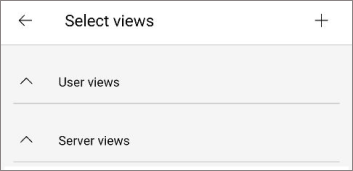
This page displays: User views and Server views.

User views are created and stored within the Eocortex app. You can manage and configure items (views and folders). For more information, see User views.
Important
The contents of the User views folder are saved when the account is authorized. In this case, all folders and views from the User views folder may be accessible to this account when authorized from another device.
Server views are stored on the Eocortex server and become available in the Eocortex mobile application when connected to the server. Access to certain server views may be restricted for specific user groups. Server folders and views can't be changed, moved, or deleted.
Hint
Any view can be added to favorites using the  button. The view added to favorites will be displayed on the Main page.
Note
In the User views and Server views folders, folders are displayed first in the list, followed by views.
There are two viewing modes available for views:  list and
  tile. To switch between modes, use the buttons in the upper right corner of the screen.
Note
The selected mode is saved for the entire Eocortex, app, but does not match the mode selected on the Cameras page.
Note
When updating the Eocortex app to version 6.0, all previously created user views are moved to the User views folder.
Note
If the Eocortex server version is lower than 4.3, all server views are saved to the Server views folder.
Search🔗
To perform a search, tap  in the upper right corner.
Search works as follows:
The search is performed across all folders and views without exception.
The search is case-insensitive.
When results are returned, folders are listed first, followed by views.
Search results can be viewed in both list and tile modes.

Navigation🔗
When opening a folder, the name of the current folder appears at the top of the screen, and below is a navigation bar with the following options:
Go up one level to the parent folder.
Go to root folder by tapping
 .
.

Preview in the list of views🔗
Each view has a preview on the left, showing the number of columns and camera previews.
If a frame can not be retrieved from the server, a gray background with a crossed-out camera will be displayed instead of the preview.
Viewing view🔗
Selecting a view opens the multi-picture page. Multi-picture is a screen grid. The camera frame refresh rate in the multi-picture view directly depends on the number of cameras displayed on the screen.

Hint
The multi-picture can be viewed in both portrait and landscape orientations.
You can zoom in/out to change the number of columns, but these changes reset after exiting the view.
Note
Camera names are shown if fewer than four columns are displayed.
As you scroll and change the number of columns, the cameras are updated.
If the number of cameras is less than 14, video streams update normally. If 14 or more cameras are active, updates switch to sequential frame-by-frame mode.
Tap a camera to enter full-screen mode. Swipe left/right to cycle through all cameras in the view.
Note
You can switch between views by swiping left or right. Swiping is only available for views within the same folder.
Tapping the  button in the top-right corner allows to:
Change the grid and camera positions
Change settings
Optimize grid.
Grid optimization maximizes screen space by dynamically adjusting cell sizes to fit camera feeds. This option can also be configured in the More tab in Video section.
The images below compares standard and optimized grid layouts.

Note
Exiting the view editor returns you to view view, with the grid automatically updating to reflect your changes.
For server views, only grid optimization is available.
User views🔗
Creating items🔗
To create a view or folder, tap the 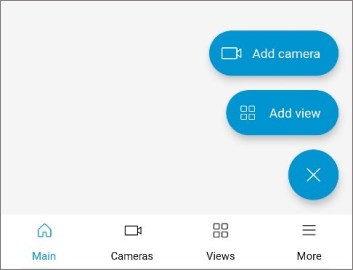 in the bottom-right corner of the screen and select the item.

Note
It is possible to create folders and views in any folders located in the User views folder.
Views🔗
To create a new view, follow these steps:
In the dialog that appears, enter a view name.
Tap Ok.
Warning
If you leave the text field empty, Ok will be unavailable.
In the window that opens, select the cameras for the new view.

When selecting cameras, you can:
Switch display modes: View cameras in a list
or a title.Search: Use the search field to quickly find cameras by name
Select or deselect: Choose cameras from specific folders.
Manage selections:
View the list of selected cameras by tapping Selected at the bottom of the screen.
Remove a camera from the selection by tapping Delete

After selecting cameras, tap
 at the bottom of the screen.
Next, place the cameras in the view.
You can use gestures to scale the size of the camera cells, and touch and hold to rearrange them.

Tap
 at the bottom of the screen.
The new view appears at the top of the list in the selected parent folder.

Folders🔗
To create a new folder, follow these steps:
In the dialog box that appears, enter a folder name.

Tap Ok.
Warning
If you leave the text field empty, Ok will be unavailable.
The new folder appears at the top of the list in the selected parent folder on the Views page.

Note
If you create a folder with a name that already exists, a number is automatically added to the name.

Context menu commands🔗
A context menu button is available for each view and folder.

The following commands are available for views and folders:
Rename allows you to rename a folder or view: to do this, enter a new name in the dialog box and tap the Ok.
Move allows you to select a folder and move an item (folder or view) to it.
Warning
When moving a folder, it becomes unavailable for selection.
Warning
In moving mode, interaction with views becomes unavailable.
To execute the command, select a folder in the tree structure and tap the . After that, a dialog box will open where you can confirm the moving of the item by tapping the Ok.
To cancel the moving, tap the  .
.
Note
After executing the command, the folder from which the item was moved will open.
Delete deletes the selected item (view or folder with all contents). Deletion of the item must be confirmed in a dialog box.
The following commands are available for the view:
Edit allows you to change the view: select cameras and place them in the view.
Make a copy makes a copy of the selected view.
Hint
The created copy of the view is moved to the end of the list of views.

Change mode🔗
There are two ways to enter Change mode:
Via context menu. In the User views folder, tap
in the upper-right corner of the screen and select Change items.

Via touch and hold.. Touch and hold any item (folder or view).
Warning
Items can only be edited within the currently selected folder.

Warning
All changes made in this mode will only be applied after tapping the confirm button . Some changes may require additional confirmation in a dialog box that appears after tapping .
To cancel all changes, tap the  .
.
In Change mode it is possible to:
Reorder items.
Touch and hold an item to drag and move it to a new position.
Warning
You can only reorder items within the same category (folders with folders, views with views). You cannot swap a view with a folder.
Move items into a folder.
Touch and hold an item, drag it over the target folder, and release.

Note
If you move an item into a folder that already contains an item of the same type (folder or view) with the same name, a duplicate counter will be added to the moved item.
Delete items.
Select an items and delete it via the context menu using the Delete command.
Hint
In
Tile view mode, you can delete an item by tapping the button located in the upper-right corner of each item.
Perform group actions.
To perform a group actions, select the desired items and tap the
. The following commands are available in the context menu:Move allows you to move selected items to a folder.
Select all selects all items in the folder.
Delete deletes the selected items.
Note
If no items are selected in the Change mode, only the Select all command will be available in the context menu.